 boojack
619eb8d6b8
The MCP catalog survived the recent API changes because it is derived
from OpenAPI, but three things drifted around it, and fixing them
surfaced a fourth.

- mcp: the adapter built each in-process API request with httptest,
  whose fixed peer address (192.0.2.1) overrode the caller's resolved
  address on the client-address middleware's second pass. Every
  anonymous MCP caller shared one rate-limit bucket. The adapter now
  presents the address resolved for the /mcp request as the peer.
- mcp: the full SpaceService is curated as space_* tools. Space and
  member updates drop path-bound fields and rely on the gateway's
  update-mask inference; accepting and declining an invitation no
  longer require an empty body for a body: "*" binding whose only
  field comes from the path.
- mcp/evals: answers re-pinned to the current seed (four users,
  22 top-level memos, 35 reactions, four spaces) and extended with
  space questions.
- store/sqlite: transactions begin IMMEDIATE. Token authentication
  records the token's last-used time asynchronously on every request,
  and the space drivers read before they write in a deferred
  transaction; when the background commit landed in between, SQLite
  refused the upgrade with SQLITE_BUSY without consulting the busy
  timeout. Roughly half of space creates over MCP failed. Taking the
  write lock up front keeps the parent-delete serialization the design
  relies on, so the SQLite stale-snapshot test now asserts that a
  concurrent delete waits for the open transaction instead.
✨ Featured sponsor: CodeRabbit — Industry-leading AI code reviews.
Memos

Fast enough for every thought. Private enough for all of them.
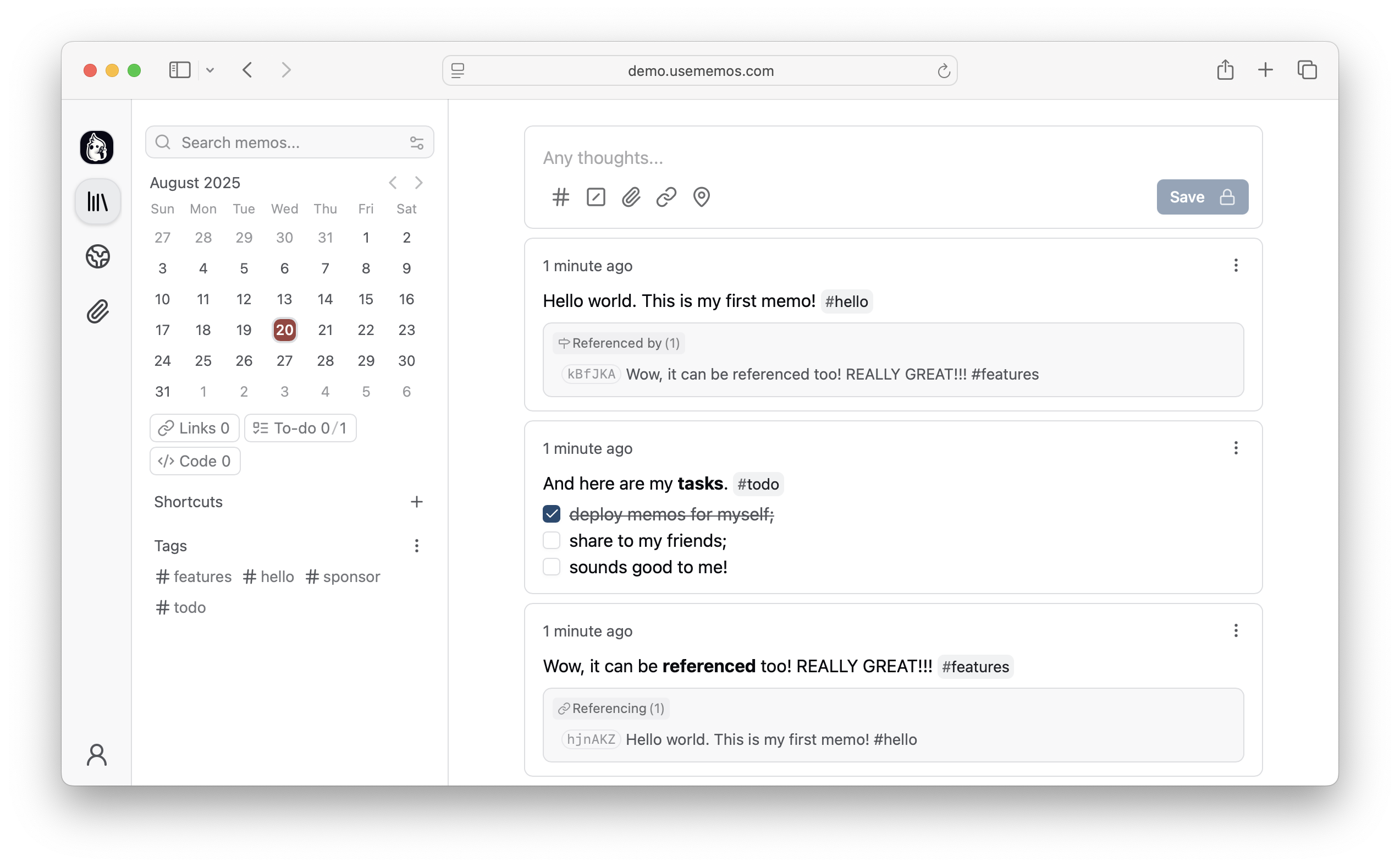
Memos is an open-source, self-hosted home for short-form thinking. Daily notes, links, work logs, and snippets flow into a chronological Markdown timeline—on infrastructure you control, without the overhead of an all-in-one workspace.
Run with Docker · Try the live demo · Read the docs




Why Memos?
- Capture quickly — Write in Markdown, attach media, and save without choosing a title, folder, or template.
- Organize lightly — Revisit notes through the timeline, search, tags, and pins.
- Share selectively — Keep memos private or publish only what you choose.
- Keep control — Self-host Memos with zero telemetry and MIT-licensed source.
Quick Start
Run Memos with Docker:
docker run -d \
  --name memos \
  -p 5230:5230 \
  -v ~/.memos:/var/opt/memos \
  neosmemo/memos:stable
Other install options are in the deployment guide.
Web Clipper
Save pages, selections, and images from your browser straight into Memos as source-linked Markdown. Get the Memos Web Clipper for Chrome or Firefox.
Sponsors



Love Memos? Sponsor the project on GitHub.
Get Help
Read the docs, join Discord, or ask in GitHub Discussions. Found a bug or have an idea? Open an issue. To contribute, see the contributing guide.